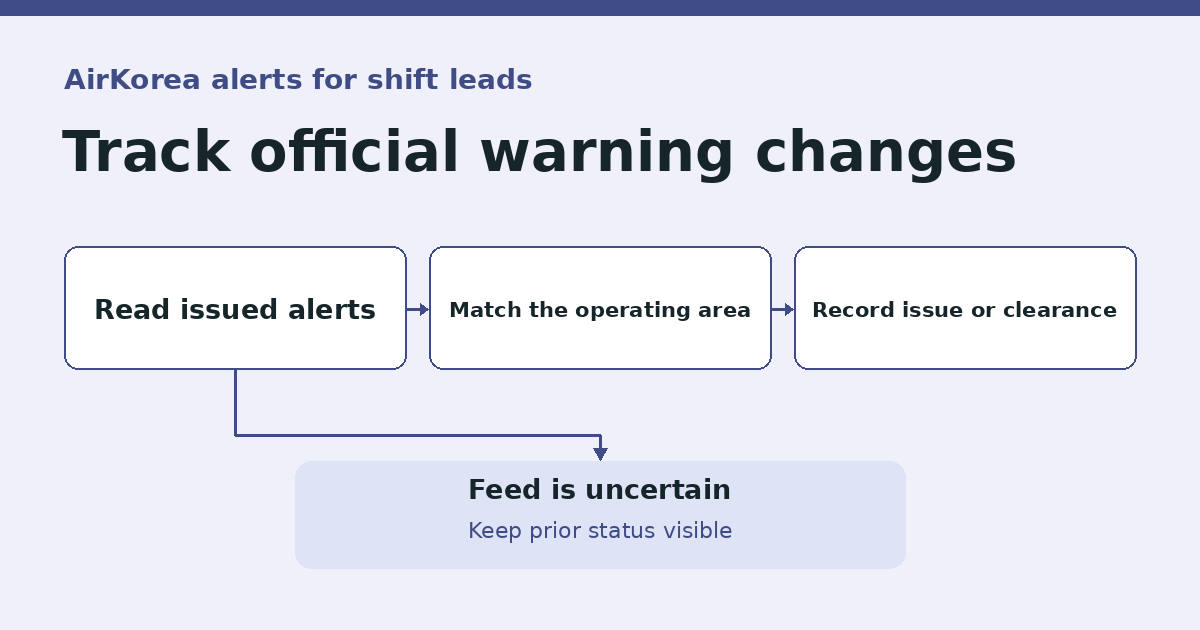
If your team in Korea wants to catch official particulate-warning changes during a shift, monitor AirKorea’s warning-status feed for the operating area’s region and zone. Flag an issue or clearance for the shift lead to review. Keep the last confirmed status visible when the feed is unavailable, along with when it was checked. [1]
Match official events to operating areas
Maintain a small table of your operating locations and the names AirKorea uses for their warning regions and zones. Ask staff to verify the mapping against the official service before rollout. The public catalog distinguishes districtName from moveName and uses PM25 as its query code for PM2.5. It also documents the request year, page parameters and public-data service key. [1]
Use the official warning records for issue and clearance. A station reading or nearby district can support a separate review, while your automation should follow the specific warning area in the official record. Store the source serial number, pollutant, warning level, area and issue time as received. Check the provider’s data-use terms before displaying feed content outside your organization. [1]
Distinguish a change from an unavailable feed
- Read the relevant result pages and validate the provider response. Record a new issue for matching areas when an event is first seen. If the same event reappears, update its record and suppress another identical internal alert.
- Record clearance only when the matching source event carries clearance information you can interpret. Display that result as the status of the individual warning. If two pollutants or overlapping warnings are present, preserve them separately. [1]
- If the feed times out, returns an incomplete set, or an area name changes unexpectedly, show an unavailable or stale state with the last confirmed check. Have staff consult the official notice before taking action. Do not infer clearance from a missing row.
Test the status transitions before relying on alerts
Replay fictional issue, repeated issue, explicit clearance, another active pollutant, and failed-page examples. Verify that a failed poll preserves the previous state and can be reprocessed without producing an extra alert. Keep customer notifications and automatic work decisions disconnected. The first live phase can show only an internal preview alongside the official notices staff already consult.
Official sources and claim checks
Official documentation opened and checked on November 17, 2026 (KST).
- The catalog describes the warning and clearance lookup, lists PM10 and PM25 selectors, and defines serial number, region, zone, issue type, issue timestamps and clearance timestamps. It lists free access, key requirements and dataset rights. Korea Environment Corporation AirKorea particulate warning status API, Korea Public Data Portal
Testing and open checks
No authenticated call, live warning or real operational notification was exercised. Verify the region mapping, missing clearance field representation, time conventions and account usage before rollout. The draft gives no health thresholds or safety determinations. Examples and test steps are documentation-based and use synthetic inputs.