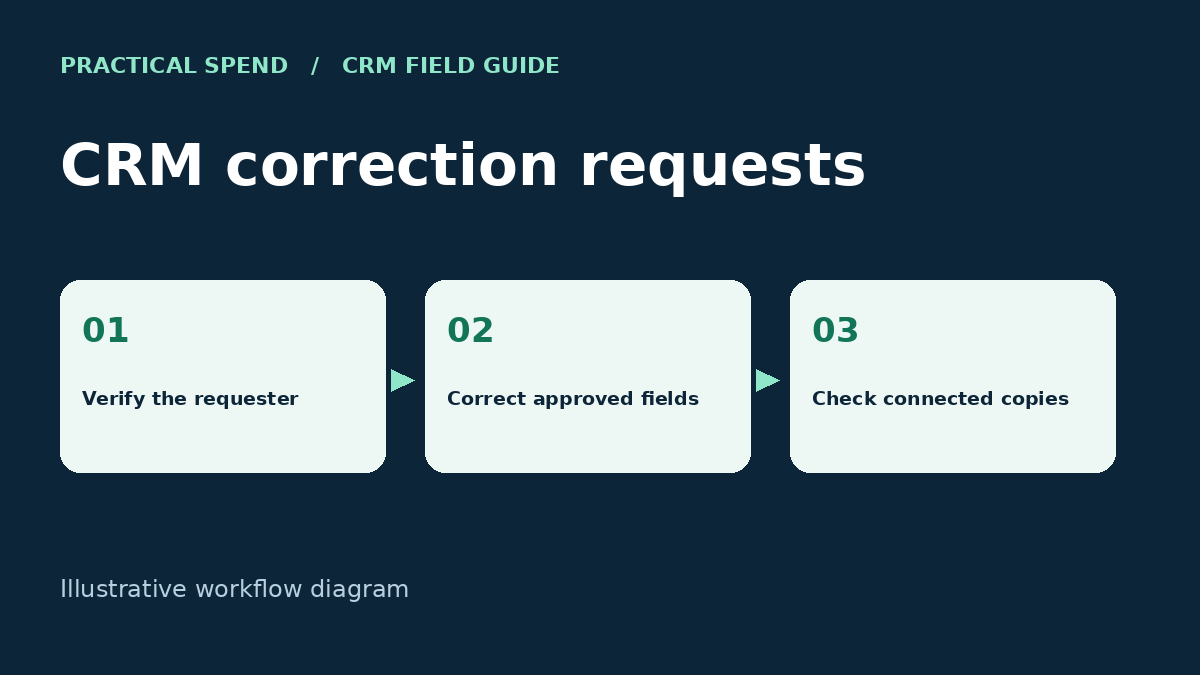
If a customer says your CRM contains the wrong phone number or address, open a correction case, verify the request through an approved channel, update the authoritative record, and check which connected systems still have the old value. Have a named person responsible for notifying the requester of the outcome.
Separate a routine update from a formal request
A signed-in customer updating a delivery address for a future order may be using an ordinary account process. A person who asks to correct data after accessing it under Article 35 of Korea’s Personal Information Protection Act may be exercising the correction right under Article 36. Article 36 provides for prompt investigation, necessary action, and notice of the result, with a qualification where another law prescribes a special procedure. Deletion has a separate qualification for information another law expressly requires to be collected. Route a formal or disputed request to the business’s designated privacy contact and check the applicable process and timing.
Use a proportionate verification step
Ask which field is wrong and which account or case the request concerns. Use an existing approved authentication method where available. An email asking to replace the account’s contact number may itself come from an unverified source, so confirm it through a trusted method before changing the account. Keep personal documents out of general chat and the shared ticket queue. If additional evidence is needed, use the approved channel and restrict access.
Check where the value is copied
| Location | Verification |
|---|---|
| Customer profile | Correct the authoritative field and confirm the saved value. |
| Open order or appointment | Confirm whether the request applies to this item and what the system permits. |
| Connected inbox or fulfillment tool | Check whether the update propagates or requires a separate action. |
| Previous transactions or required records | Have the responsible person determine whether to preserve the historical entry or add a correction. |
Avoid copying the incorrect and corrected values into several tracking documents. Keep a case reference, the scope of the change, the person who handled it, and evidence appropriate to your approved process.
Notify and verify
Use an approved reply channel. State which fields or records were handled, the effective scope, and any remaining issue the customer needs to know about. Use masked values where appropriate. In a fictional test, update a demo delivery profile while an order is open. Check whether the order inherited the change before promising that the next delivery will use it.
FAQ
What if I cannot verify the requester? Keep the case open and direct the person to the approved verification route. Restrict the response to what you can disclose before identity is verified.
Can every connected copy be overwritten? Check the purpose of each record and any applicable requirements. A current profile and a historical transaction may need different treatment.
Official sources and evidence
Checked November 10, 2026 (KST). The listed findings are documentation-based. Examples and workflow decisions are editorial recommendations.
- Korean National Law Information Center — PIPA Article 36 — Covers correction or deletion requests after access under Article 35, prompt investigation and necessary action, result notification, and exceptions.
- Korean National Law Information Center — PIPA Article 16 — Covers the minimum information necessary for the purpose in applicable collection.
Verification record
- No live account, customer, transaction, or import tests were performed. Examples use fictional data.
- Unverified in practice. Confirm current statutory procedure and timing, identity checks, and downstream correction process.
- Search demand and keyword difficulty were unmeasured.