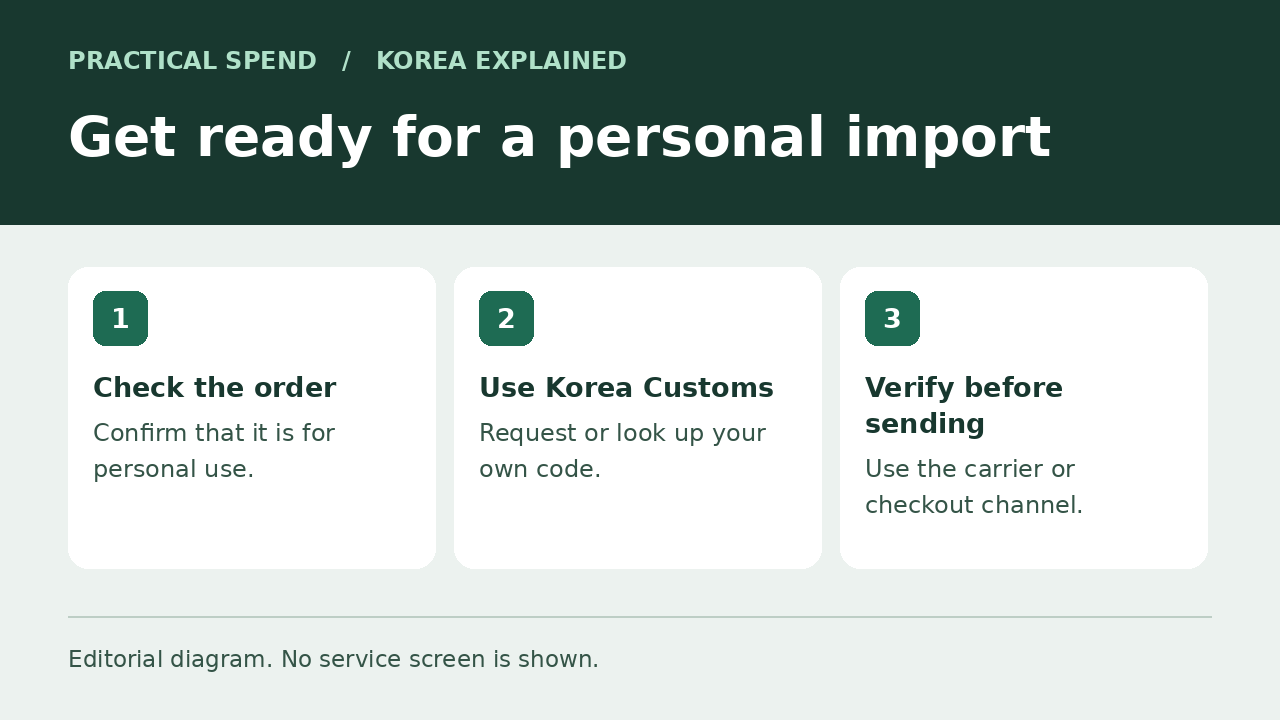
If you are a foreign resident ordering goods from abroad for personal use, Korea Customs Service says to use a Personal Customs Clearance Code for the e-commerce import. A passport number or foreign registration number cannot substitute for the code on that declaration. Use the official customs portal to apply or check a code you already have, then make sure your checkout details match the recipient information on file.
Get the code through Korea Customs
개인통관고유부호 is the Korean term for the Personal Customs Clearance Code. Start at Korea Customs Service’s English issuance guide or its E-Commerce Customs Clearance Portal. The agency’s August 2026 launch notice lists issuance, renewal, and updates. It also describes pre-registration for people planning an in-person issuance visit. A Korea Customs FAQ describes an application route for foreign nationals who have a foreign registration number. The FAQ shows the older portal. If you lack that number or cannot complete the current online check, ask Customs which route and documents it accepts before traveling to an office.
The code is for personal customs clearance. If you plan to import inventory for resale, tell Korea Customs or your broker what you intend to sell and ask which declaration route applies to the shipment.
Check the recipient details before checkout
Compare the recipient name, Korean delivery address, phone number, and code against the information recorded with Customs. If you recently moved or changed phone numbers, review your customs record before ordering. Keep access to the email linked to your record because some checkout flows use it for verification.
For codes newly issued or updated on or after August 28, 2026, the launch notice describes a one-time authentication flow at participating checkouts. If the details match, Customs may email an authentication number for entry on the order screen. The notice describes different handling for previously verified customers at accredited partners and for older records that have yet to be updated or renewed. Follow the instructions for the checkout you actually use. Korea Customs distinguishes the one-time authentication number you may receive from a separate one-time customs identifier sent to qualifying shopping platforms. Keep using your own Personal Customs Clearance Code when the checkout asks for it. Keep your code and any authentication number within the official transaction channel.
Check an older code before placing an order
Korea Customs announced a one-year validity period for newly issued codes starting in 2026 and a transition for codes issued before 2026, tied to the holder’s birthday in 2027. Check the expiration shown in your own record. For customs counseling, the agency lists 125 in Korea, 9 a.m. to 6 p.m. Korea time on weekdays, excluding public holidays. The English web guidance is available. English phone service for a specific call was not confirmed.
Official sources and verification
- Korea Customs Service: code issuance supports the foreign e-commerce recipient rule and excluded substitute numbers. Checked November 12, 2026 (KST).
- Korea Customs Service: e-commerce portal launch and authentication supports the portal functions, cutoff date, checkout fields, and partner and older-code handling. Korea Customs Service: renewal announcement supports the validity and transition rules. Checked November 12, 2026 (KST).
- Korea Customs FAQ supports the foreign-registration-number application route in the older system. The current portal displays issuance and renewal options. Korea Customs: one-time customs identifier guidance explains the separate identifier supplied to eligible marketplaces. Checked November 12, 2026 (KST).
- Customs counseling supports the number and hours. Checked November 12, 2026 (KST).
- Hands-on status: No code was requested or renewed, no checkout was tested, and no call was placed. Individual identity verification and accepted documents remain unverified. Recheck the active portal and retailer flow before publication.