If you are filling out a Korean form and get stuck on a field label, look up its key word in the National Institute of Korean Language’s Korean-English Learners’ Dictionary. The official tool accepts Korean or English search terms. Once you understand the word, use the issuing office’s current instructions to find out exactly what it wants you to enter or submit.
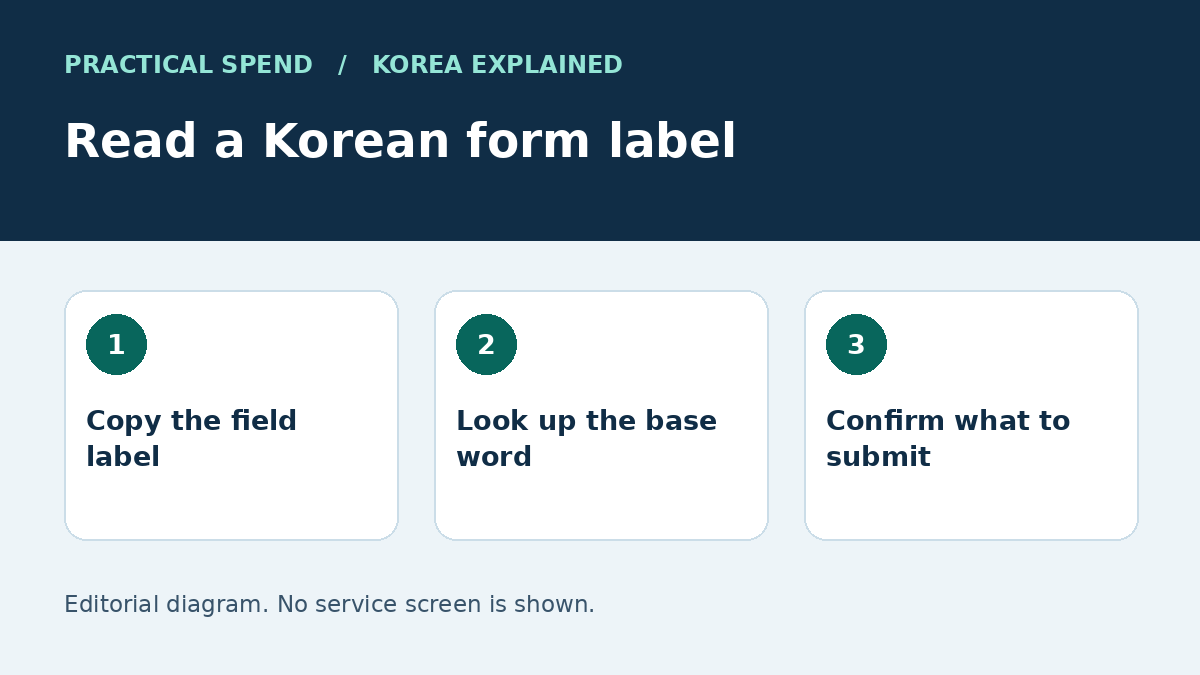
Start with the label, then read the surrounding instruction
Copy only the unfamiliar label. For a long phrase, search the main noun or verb first. In 제출 서류 (documents to submit), for example, you can look up 제출 (submission) and 서류 (documents) separately. Then read the line below the heading to see which documents the office actually lists.
| Label you may see | Working meaning | What to check |
|---|---|---|
| 신청인 | Applicant | Whose name goes in this field? |
| 제출 서류 | Documents to submit | Which documents and file formats does the office accept? |
| 접수 | Receipt or intake | Has the office received the form, and where can you check its status? |
| 구비 서류 | Required supporting documents | Does the checklist vary by applicant type? |
These are language examples. The form and the office’s guidance determine the procedure.
Ask one question the office can answer
Suppose a form says 신분증 사본 (copy of an identity document). Understanding the phrase still leaves a practical question about which document the office accepts for your application. Ask, “Which identity document do you accept for this application, and do you need a paper copy or an upload?” Give the form title and field label. Use the official submission channel if the office requests the document.
Before submitting
Check the form version, required fields, document list, and deadline on the issuing office’s website. If the page shows 접수, check the status guide or confirmation notice for what happens next. Keep the official instructions and any receipt together so you can refer to them if the office asks for a correction.
Official sources and evidence
- Confirmed in official documentation — Official bilingual dictionary interface, Korean or English search input and advanced search. Checked November 10, 2026 (KST). National Institute of Korean Language — Korean-English Learners’ Dictionary
- Editorial guidance — Checklists, suggested questions and hypothetical examples are editorial applications of the cited guidance.
- Unverified and hands-on status — No real form was filed. The labels are editorial language examples. Accepted documents, ID requirements, submission format, and deadlines are specific to the issuing office.
- Recheck — Check the current official guidance before using the service; procedures, prices and contact routes can change.