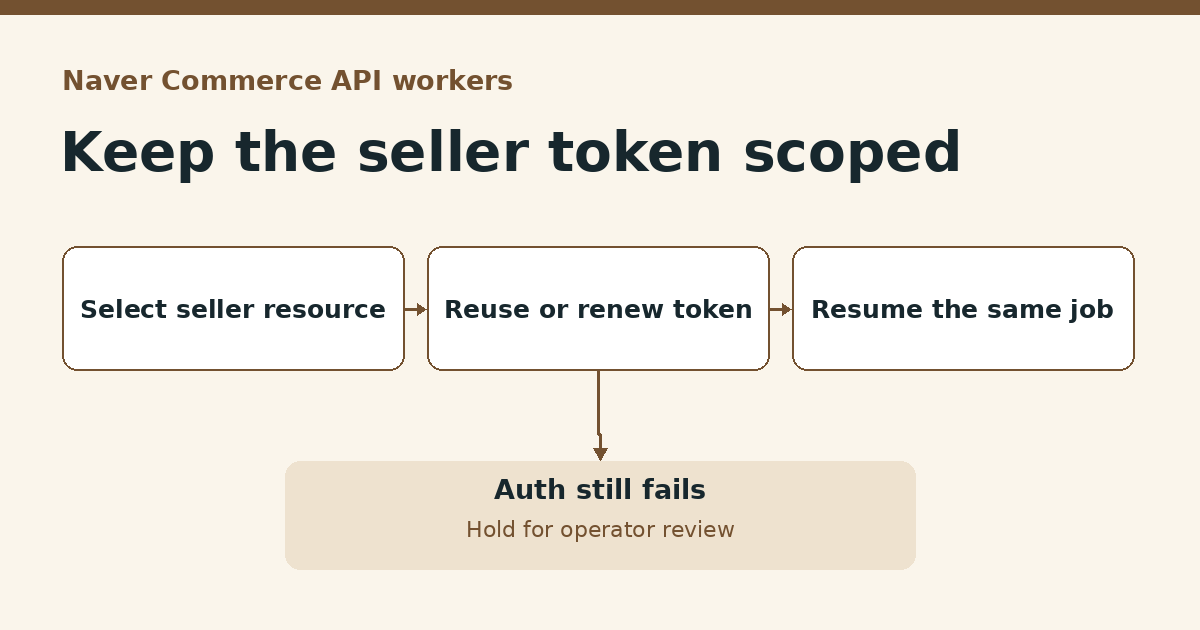
For a Naver Commerce API job serving a Korean Smart Store, cache the token under the exact resource identity it was issued for and recover authentication before resuming the same job. Naver scopes issuance by type and account_id. Its authentication guide describes refreshing after a 401 response with GW.AUTHN. [1][2]
Keep the seller context attached to every job
Record the application, intended resource type, seller identity when applicable and the job reference before requesting a token. Associate cached credentials with that resource key. Have the worker verify the key before making a business request.
Store credentials in a server-side secret store. Use the documented signing method for issuance and keep signatures, tokens and authorization headers out of support logs. Record nonsecret timing and error codes for diagnosis. The token endpoint’s documentation defines a three-hour lifetime and conditions under which it returns the existing token or issues a replacement. [1][2]
Recover authentication with bounded work
- Before a job starts, retrieve the correct cached token and check its tracked validity. Serialize refresh work for the same resource so several workers do not all request a replacement.
- If an API call returns 401 with
GW.AUTHN, use the provider’s documented token issuance fallback, then retry the read once under the same seller context. If the error persists, stop that job and route the nonsecret error details to the operator. [2] - If the interrupted operation was a write with an unknown result, read the current destination state and reconcile it against the planned change before replaying it. Renewed authentication alone cannot resolve whether an earlier business action completed.
Make the overnight failure visible
For a catalog read that fails after some pages, retain the last complete output and mark the new run incomplete. Resume from a checkpoint appropriate to that endpoint after authentication is restored. Keep partial output from replacing the approved file used by the Korean shop team.
Use mocked tokens and fictional seller identities to test expiry, a signing error, two concurrent refresh requests and a resource-key mismatch. Confirm that the mismatch prevents a call and persistent failure leaves one actionable task. A later authorized pilot should begin with a read-only endpoint whose result the merchant can verify in Seller Center.
Official sources and claim checks
Official source content opened and checked on November 19, 2026 (KST). Workflow safeguards and example operating procedures are editorial recommendations derived from the documented behavior.
- The token is scoped by type and account_id, has a three-hour lifetime, and issuance may return the current token depending on remaining validity. Naver Commerce API token issuance
- The guide documents server-to-server client credentials, Bearer authentication, signed token requests and a refresh fallback for 401 with GW.AUTHN. Naver Commerce API authentication