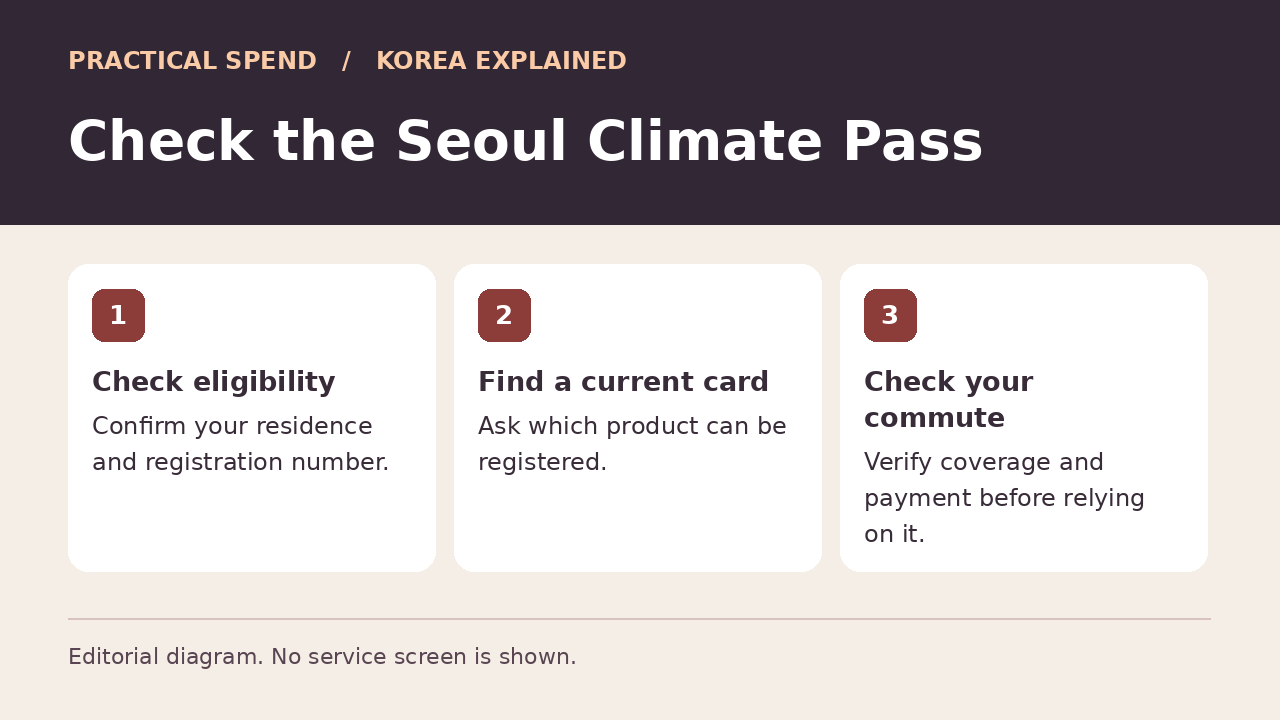
If you live in Seoul and used the old 30-day Climate Card, start with the Climate Pass rules now. Seoul launched the Climate Pass on September 1, 2026, through the national K-Pass program. The city says its Climate Pass benefits are for Seoul residents. Foreign nationals can enroll in K-Pass with a Foreign Resident Registration Number. Check your residence verification and how to register the card before relying on the benefit for a commute.
Identify the product before paying
기후동행패스 (“Climate Pass”) is the resident benefit within the national 모두의카드 (“Everyone’s Card”) system. Seoul’s English guidance says the old prepaid 30-day Climate Card could only be recharged through August 31, 2026. It separately lists short-term Climate Card passes. If you see a product called “Climate Card” at a kiosk, check which duration it offers and whether you are looking at the short-term product or a card for K-Pass registration.
Verify your Seoul residence and card
Open the official K-Pass portal and check the foreign-user enrollment route. Seoul’s September 30 eligibility FAQ says foreign users need a Foreign Resident Registration Number and a supported identity verification method, such as mobile identity verification or an accepted certificate. If verification fails, call K-Pass at 031-427-4415. If the automatic address check fails, the FAQ describes submitting residence evidence after signup. Check the current document label and upload instructions in K-Pass before obtaining a document.
If you already use a registered K-Pass card, check your verified address first. Seoul says qualifying existing K-Pass users with verified Seoul residence can receive the local benefit automatically. If you need a new card, Seoul’s current FAQ describes postpaid and prepaid routes. A postpaid applicant obtains the card from a participating issuer and registers it with K-Pass. For a prepaid product, the FAQ describes registering the card and reimbursement account with its issuer, followed by K-Pass registration. Check the issuer’s identity, account, and product requirements before purchase.
Make the first commute a confirmation check
List the subway lines and bus services you use, including any segment outside Seoul. Check the official program’s coverage and start date for your selected card, then review the account after initial rides. For a specific card, ask the issuer which registration and payment details it requires. Seoul’s English policy page and K-Pass are the official starting points for current rules.
Official sources and verification
- Seoul’s English Climate Card policy page supports the 30-day recharge cutoff, short-term pass distinction, residency and registration overview. Checked November 13, 2026 (KST).
- Seoul’s English transition FAQ supports the foreign registration number and manual residence verification. Seoul’s foreign-user eligibility FAQ supports the identity verification requirement and help number. Seoul Climate Pass FAQ supports the existing-user and new card routes. Checked November 13, 2026 (KST).
- Hands-on status: No account, residence check, card issuance, ride, or reimbursement was tested. Confirm issuer-specific acceptance, route coverage, and activation before publication or enrollment.