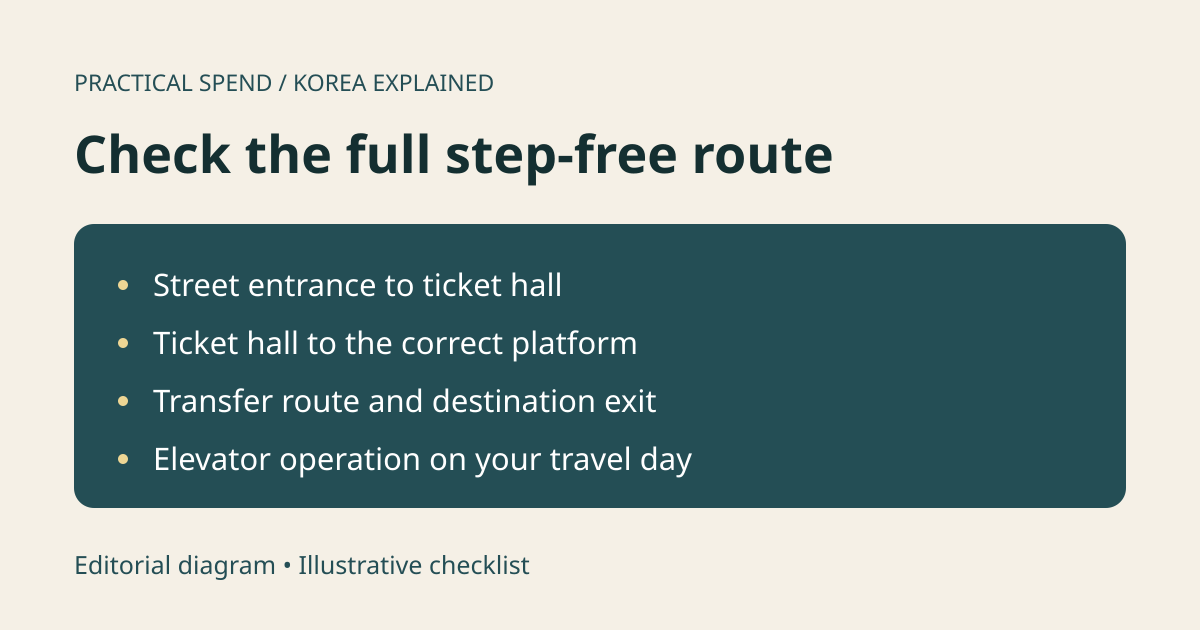
Plan your Seoul subway trip around a continuous step-free route: street to platform, platform to platform at any transfer, and platform to street at your destination. Seoul’s English accessibility tables help you identify stations with elevators. Confirm which lifts connect the levels you need and whether they are operating before you leave.
Look up the station by line
Use Seoul’s Subway Accessibility Facilities guide to find the station under your train line. A transfer station can have different listings for different lines. Note the station name, line number and train direction at both ends. Then use the station’s own information, or ask staff, to confirm which street entrance has the lift you can reach from your starting point.
The city’s tourism guide explains why this matters: at many stations the first elevator takes you to the ticket hall, where you may need a second one to reach your platform. Allow extra time if the accessible entrance is on the other side of a busy road or if you need to change levels more than once.
Check three connections
- Starting station: Find the street elevator and confirm it connects to the right direction of travel. Save the exit number or nearby landmark if the operator provides one.
- Transfer: Check how to get between the two platforms. Ask whether you can stay inside the fare gates and whether a lift or a staffed route is needed.
- Destination: Confirm both the platform-to-hall and hall-to-street segments. If the trip includes a different operator’s line, check that operator’s station information as well.
Seoul Metro’s Korean chatbot has a station facilities option, 역사편의시설 (station amenities). At the station, look for 엘리베이터 (elevator) or ask staff: “계단 없이 이 승강장까지 갈 수 있나요?” (“Can I reach this platform without using stairs?”) If you also need help with the gap between the platform and train, ask about boarding assistance separately.
Verify before traveling
Seoul Open Data describes an operator feed with elevator locations and operational status. The English city table is a reference for facilities. For the trip you are taking today, ask station staff or the operator about outages and the alternate route. For English help with general Seoul transit information, the Dasan Call Center lists 02-120, then 9, then 1, weekdays from 9 a.m. to 6 p.m., excluding public holidays.
Scope and limitations
No route was traveled and no live elevator status or staff response was checked. Recheck operating status, transfer connections and any boarding assistance on the travel day.
Official sources
- Seoul Metropolitan Government, Subway Accessibility Facilities — Checked November 14, 2026. Supports station-by-line facility lookup. The published counts are a reference for planning.
- Visit Seoul, Accessibility — Checked November 14, 2026. Explains street, ticket hall and platform elevator connections and differences by station.
- Seoul Open Data, Seoul Metro elevator dataset — Checked November 14, 2026. Documents location and operation fields for Seoul Metro’s elevators. No live record was retrieved.
- Seoul Metro, customer chatbot — Checked November 14, 2026. Shows the station facilities option.
- 120 Dasan Call Foundation, Foreign-Language Consultation — Checked November 14, 2026. Supports the English menu, hours and scope.