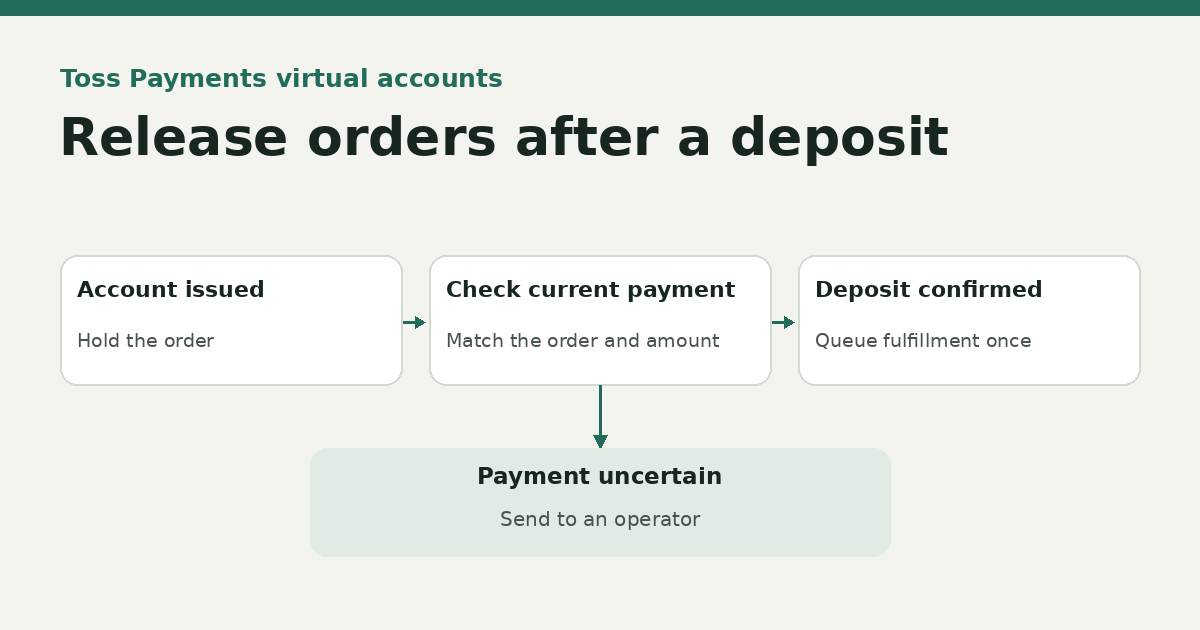
If your Korean online store accepts Toss Payments virtual accounts, release an order to fulfillment only after the provider reports a completed deposit for the order and your system verifies the amount. Account issuance leaves the payment at WAITING_FOR_DEPOSIT. Your checkout can show that the account is ready while your warehouse queue keeps the order on hold. [1]
Build the deposit check into fulfillment
- Record the order at issuance. Keep the internal order ID, expected KRW amount, Toss
paymentKey, and current fulfillment state. For the documentedDEPOSIT_CALLBACKintegration, store the callback verification secret from the issuance response in restricted server-side storage. Keep it out of support tickets, tracking sheets, and debug logs. [1] - Treat the callback as a prompt to verify. Validate the callback secret using the value captured for that order, then retrieve the current payment with the saved
paymentKey. Check that the payment belongs to the intended order, the amount matches your order record, and the status isDONE. Put unknown orders, verification failures, and lookup errors in a review queue with a short reason code. [1][3] - Queue packing once. Within the same database transaction, record the order as eligible for fulfillment and insert a fulfillment task with a unique key for that order and action. If a callback is delivered again, the worker should see the existing task. Have the packing or shipping integration use a stable request reference and check whether the shipment already exists after an uncertain response. [2]
- Acknowledge delivery after recording the work. Toss documents a successful acknowledgment as HTTP 200 and retries unsuccessful deliveries. Design the receiver to acknowledge valid events after it has recorded the work durably so a slow packing system does not block webhook processing. [2]
Decide what to do when a payment changes
Toss documents that subscribing to both DEPOSIT_CALLBACK and PAYMENT_STATUS_CHANGED can produce two events for the same payment. Do not use CANCEL_STATUS_CHANGED as the domestic virtual-account cancellation hook: it covers asynchronous foreign payment methods in China and Southeast Asia. [2]
The following are proposed safety controls, not guarantees supplied by Toss. For a validated event linked to a known order, retrieve the current payment. Require DONE, the correct order and expected amount, no cancellation inconsistent with the approved order, and current fulfillment eligibility. Do not rely on totalAmount alone: it retains the initial amount after cancellation. Check the status and cancellation history too. [3]
A non-DONE state, full or partial cancellation, lookup failure, amount mismatch, or changed order should hold new and existing unstarted fulfillment tasks for review. An unverified notification must not itself change an arbitrary order. The worker should repeat payment and order checks immediately before shipment release, and serialize local state changes and task claims per order or use conditional updates against the current order version. If a partial cancellation is legitimate, an operator must approve the remaining order before a new release decision.
A local database transaction cannot make the provider’s payment and an external carrier’s shipment atomic. A cancellation may race with the final check or arrive after dispatch. Use a stable shipment reference, inspect uncertain responses before retrying, and route an already-created label or shipped parcel to manual reconciliation with the warehouse and carrier. Do not automatically promise that shipment can be stopped.
Test the handoff before connecting a warehouse
Connect an isolated receiver to the test store and simulate a deposit through the Developer Center test transaction view. Send packing output only to a test queue. Verify that issuance creates zero packing tasks, a valid deposit creates one, and repeating the event keeps the count at one. Simulate a lookup timeout, mismatched amount, return to pending, full cancellation and partial cancellation after a task has been queued. Replay both subscribed event types for the same payment and race a cancellation against the worker’s task claim. Verify that invalidated unstarted tasks do not release shipments and that a shipment already submitted becomes a manual reconciliation case. Keep customer messaging and live shipment creation disabled throughout the exercise. [1]
Official sources and claim checks
Checked on November 15, 2026 (KST).
- Account issuance returns WAITING_FOR_DEPOSIT, deposit changes it to DONE, the DEPOSIT_CALLBACK secret is compared with the issuance response, and deposits can be simulated in the Developer Center test transaction view. Toss Payments virtual-account payment window guide
- Virtual-account events can include issuance, deposit, and cancellation. Two subscribed event types can describe the same payment, delivery is retried, and a rare reversal from DONE is documented. Toss Payments webhook integration
- The payment retrieval endpoint takes a paymentKey and returns a Payment object. The Payment definition explains totalAmount and cancellation data. Toss Payments API guide and Core API Payment definition
Testing and open checks
The merchant’s live contract, bank coverage, and fulfillment integration were not tested. Merchant account fees are outside this guide. The workflow and dry-run checks are documented examples. No production account was exercised. Procedures and test cases are based on the cited documentation and use synthetic data.