If you need to know the air quality where you’ll work or run errands in Seoul, start with the city’s district air quality map and select the pollutant you want to check. Use the district where you’ll actually be. If the map shows no usable reading or timestamp, open AirKorea’s English hourly trends and look for a recent measurement for the area. [1][2]
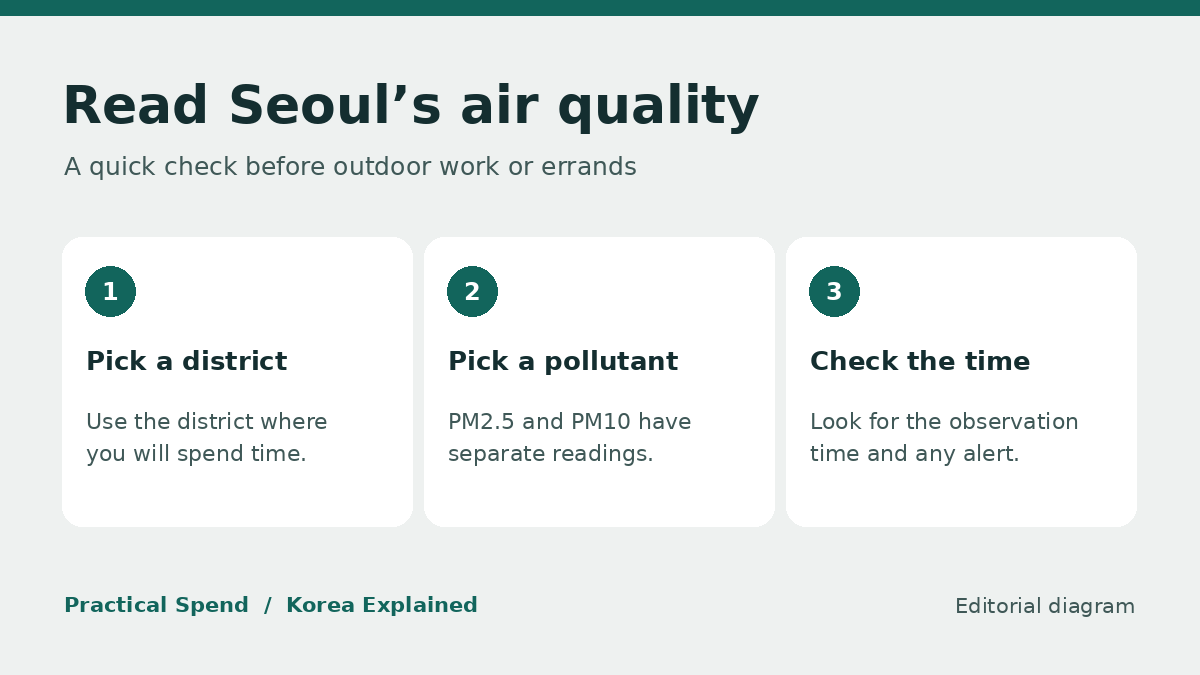
Start with the right location and pollutant
- Open the Seoul Air Quality page. Find your gu (구), or district, on the map. The city says the district name appears when you hover over it on a computer.
- Choose PM2.5, labeled fine particles, or PM10, labeled coarse particles on the English city page. In Korean you may see 초미세먼지 for PM2.5 and 미세먼지 for PM10. Each pollutant has its own legend. Read the category against the legend for the selected pollutant. [1]
- Check how recent the reading is. On AirKorea’s hourly trends page, use the Area controls and look for the latest plotted measurement. AirKorea displays particle concentrations in micrograms per cubic meter (µg/m³). The plotted measurements are hourly averages, while the reference lines for PM2.5 and PM10 represent 24-hour standards. Read them as two different time windows. [2]
Check whether you’re looking at a forecast or an alert
Seoul shows Air Quality Forecast and Air Quality Alert in separate sections. Read the pollutant and the issue time in each. For example, if you’re scheduling outdoor work in another district tomorrow, check that district’s latest available measurement and separately see when the forecast was issued. If a date shows zeros or a reading is blank, retry in a browser with scripts enabled or use AirKorea. [1][2]
When you need help
The English city page has map legends and alert labels. Its footer lists 02-120 for Seoul City Hall inquiries. For a station-level question, AirKorea provides a contact link and lists the Korea Environment Corporation air-measurement team at 032-590-3516. English phone support for that team was not verified. [1][2]
Before heading out — Verify the district, pollutant, and time. For a later outing, open the forecast and alerts again before you leave.
Official sources and claim checks
Checked 2026-11-15 KST. Recheck live readings, timestamps, forecasts, and alerts before using the guide.
- Seoul Metropolitan Government — Air Quality — English district map, pollutant legends, separate forecasts and alerts, City Hall contact.
- AirKorea — Hourly Trends — area selectors, hourly measurements, particulate concentration units, 24-hour reference lines, and agency contact.
Scope of verification: The city page’s live values and map interaction were not confirmed in a full browser session. No observation or alert from the check date is reported. Confirm a populated station reading and time before relying on it.