When should you move a step into a Make subscenario? Do it when multiple workflows need the same bounded operation and can agree on the inputs and result. Start with a reversible task such as classifying a service request by branch code.
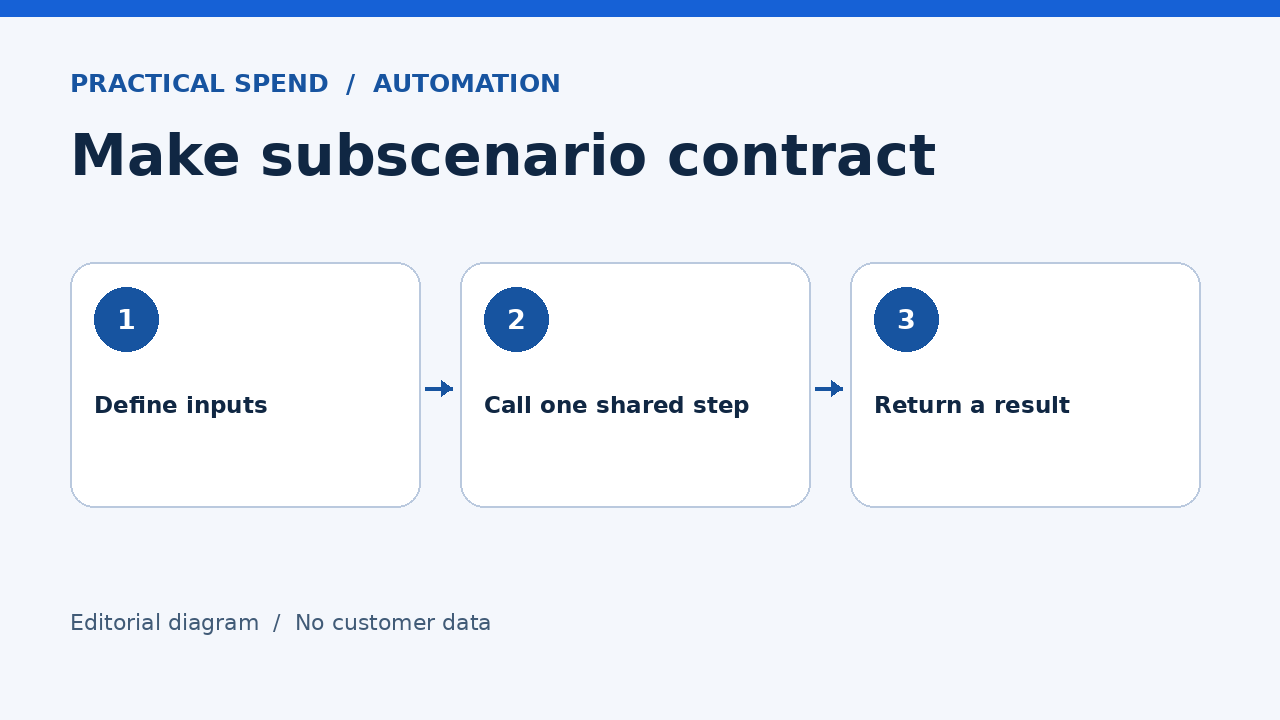
Define the contract
Write down the fields, allowed values, and result. For a fictional multi-location repair business, the caller supplies a branch code and service type. The subscenario returns a routing outcome and, when a match exists, the internal destination reference. The caller keeps the customer’s contact data. Agree on how to represent an unknown branch and where exceptions go.
Connect the shared step
Make documents scenario input and output definitions, calling a subscenario, and returning values to the caller. Configure the child scenario with the agreed fields and wire each caller to it. Give the shared step one job. The callers can decide whether to log the result, alert staff, or wait for review. A classification rule should not issue refunds or send customer messages as a hidden side effect.
Maintain it without surprising callers
For a compatible change, keep required inputs and output meanings stable. If you need a breaking change, stand up a new contract and move one caller at a time. Record which caller uses which version. If a lookup fails, return a deliberate review outcome when appropriate. Route infrastructure errors through the caller’s error handling rather than reporting a false successful classification.
Test both callers with synthetic cases
Check a valid branch, an unknown branch, a missing required value, and an unavailable lookup. Inspect the returned values from each caller. Before rollout, confirm the Make account’s feature availability, usage, and access permissions. Use a test route for any downstream actions and leave customer-facing sends disconnected.
Official sources and evidence
Checked November 10, 2026 (KST).
- Make — Scenario inputs and outputs — Official docs describe typed inputs and outputs, subscenario calls, and Return output.
- Korea Law Information Center — PIPA Article 16 — Official text supports limiting collection to the purpose. Passing only operational codes is a proposed design practice.
Verification notes
Evidence confirmed: The claims mapped above reflect the cited official documentation or legal text.
Editorial recommendation: Workflows, checklists, and examples are proposed operating practices.
Hands-on testing: None. Examples are synthetic.
Unverified: No Make scenario, caller contract, plan availability, or live integration was tested.