What should you ask for on the first quote request? Start with what you need to understand the job and one way to respond. If a detail only becomes useful after the customer chooses to proceed, move it to the next stage.
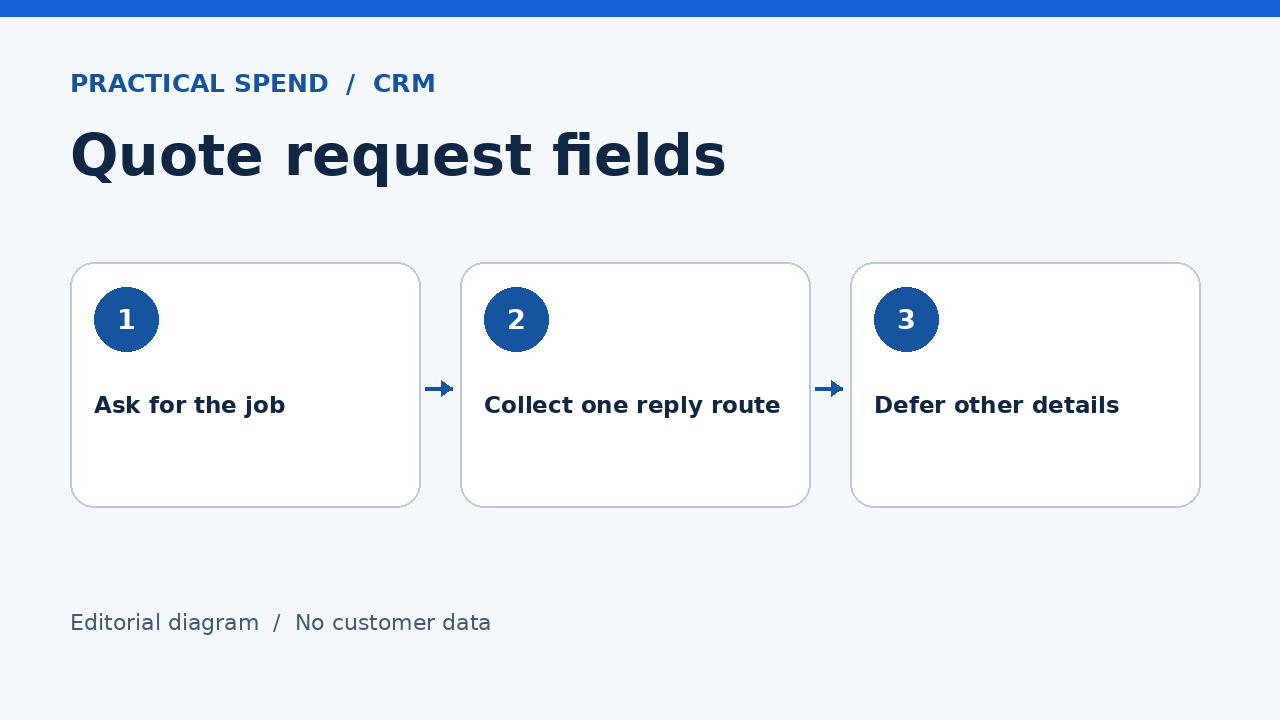
Design the form around the first decision
A mobile service business usually needs to decide whether it covers the area, handles the type of work, and can offer a realistic estimate. Start with service type, a short description, and a broad service area when location affects coverage. Ask the customer to choose a reply method and enter the corresponding contact detail. An in-store service may have no reason to ask for an area at all.
For example, a hypothetical detailing shop might ask for a vehicle category and desired service. If on-site work is requested, the district can help establish coverage. A full street address can wait until the shop is arranging the visit. If a photo helps estimate the job, explain what to photograph and ask the customer to exclude plates, faces, and documents.
Review every required field
Ask staff to name the decision each field enables. If they cannot, remove the field or defer it. Replace a large “anything else” box with a short prompt about the work. Avoid requesting identity numbers, card details, or full addresses for a preliminary estimate when they serve no purpose.
Korea’s Personal Information Protection Act permits collection and use on specified bases, including certain necessary actions requested by the individual during contract formation. Determine which basis actually applies to your intake. The law also limits collection to the minimum needed for the purpose. If you rely on consent, review the Article 15 disclosures and the Article 16 rules for information beyond the necessary minimum.
Carry only the useful fields into the CRM
Define the purpose of each mapped field, who can see it, and how to handle information pasted into a free-text box by mistake. Keep the quote reply route separate from any promotional permission record. The form must make sense even when a customer chooses no optional fields.
Test it with three fictional requests
Use a straightforward job, an out-of-area job, and an ambiguous job requiring clarification. Check that staff can route each request and ask for any missing detail at the right stage. If all three require extra questions, revise the prompt before adding another required field.
Official sources and evidence
Checked November 10, 2026 (KST).
- Korea Law Information Center — PIPA Articles 15–16 — Official text supports lawful bases, disclosures when relying on consent, and minimum necessary collection.
- Korea Law Information Center — Information and Communications Network Act Article 50 — Official text supports separating quote replies from the checks for promotional messages.
Verification notes
Evidence confirmed: The claims mapped above reflect the cited official documentation or legal text.
Editorial recommendation: Workflows, checklists, and examples are proposed operating practices.
Hands-on testing: None. Examples are synthetic.
Unverified: No live form or CRM mapping was tested. The lawful basis for a particular business remains case-specific.