How do you keep an old webhook from changing a shipped order back to “paid”? Compare the incoming update with the current source state or a documented event revision before writing. Make can process arrivals one at a time, but network delivery can still put an older update behind a newer one.
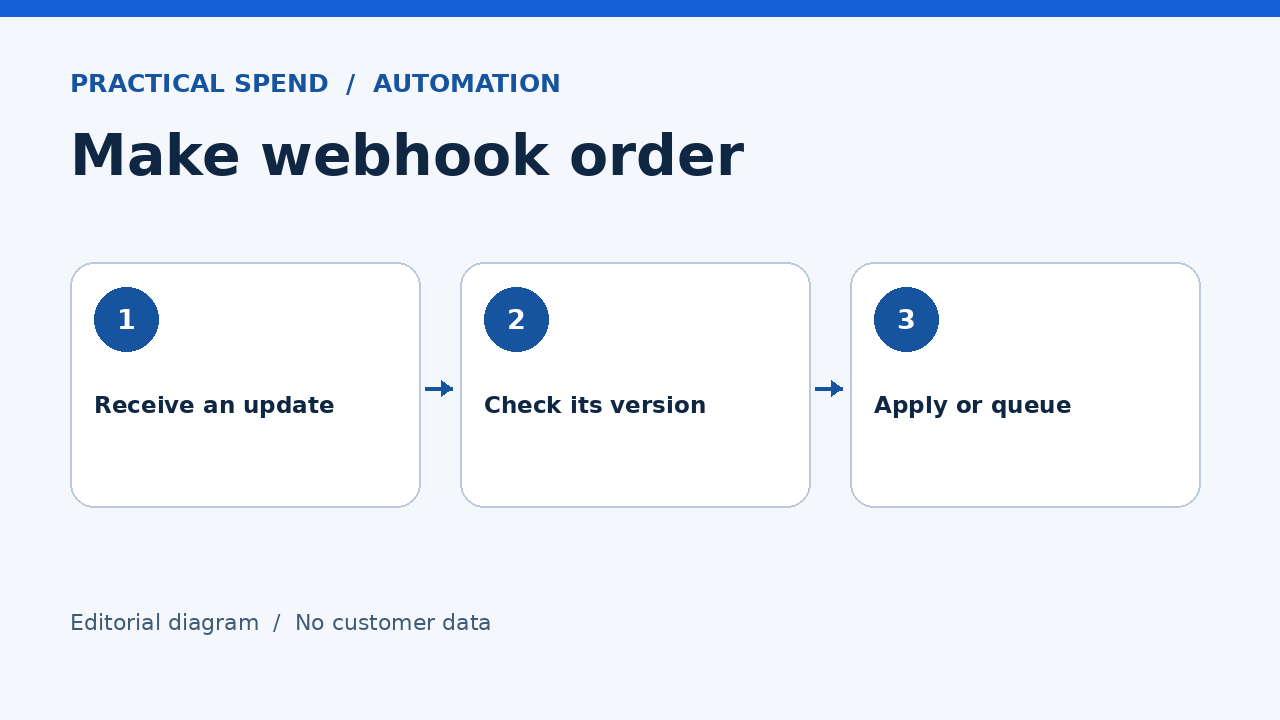
Decide which system owns order status
Choose the store or order system as the authority. Identify an immutable order reference and, if supported, a trustworthy sequence or revision issued by the source. Record the last applied revision with the destination order. Compare revisions only within the same order and source. If the source has no reliable revision, fetch the current order through an authorized connection and use that result, or queue the event for review. A receipt timestamp only tells you when Make received the message.
Apply the update safely
Reject an older revision and acknowledge a revision already handled. For a newer revision, validate whether the state change makes sense. Keep the revision and status together so overlapping writes cannot advance one without the other. Use a conditional write or a single authoritative writer when your destination supports it. If you cannot prevent concurrent writes in the destination, keep the workflow in review mode for consequential changes.
Make documents that its scenario setting to process data in order serializes webhook runs. It can also pause subsequent runs when there are unresolved incomplete executions. Decide who checks the stalled queue and how they confirm which order states need recovery before releasing it. Keep the logs to order references and operational fields where possible.
Test reordered and repeated deliveries
In a synthetic environment, deliver revision 12 before revision 11. Repeat revision 12 and check the final destination state and write history. Simulate an error after a write and confirm that your recovery procedure inspects the stored state before applying an update again. Leave live notifications, shipment creation, and payment steps disabled during the exercise.
Official sources and evidence
Checked November 10, 2026 (KST).
- Make — Scenario settings — Official docs confirm parallel default webhook processing, sequential processing, and pauses for incomplete runs.
- Make — Incomplete execution options — Official docs describe queue behavior and storage limits.
- Korea Law Information Center — PIPA Article 29 — Official text establishes safety measures for personal information.
Verification notes
Evidence confirmed: The claims mapped above reflect the cited official documentation or legal text.
Editorial recommendation: Workflows, checklists, and examples are proposed operating practices.
Hands-on testing: None. Examples are synthetic.
Unverified: Store API revision semantics, destination concurrency controls, and the Make account limits were not tested.