Category: Korea Explained

  • How to Get a Seoul Subway Delay Certificate

    How to Get a Seoul Subway Delay Certificate

    If a late Seoul subway train disrupted your commute, look for 간편지연증명서 (“simple delay certificate”) in Seoul Metro’s official service menu. Choose the record that matches your date, line, direction, and time if it is listed. If your train ran on another operator’s section, start with that operator or ask station staff which company handles the segment. Before sending the document to a manager or school, ask what proof it accepts.
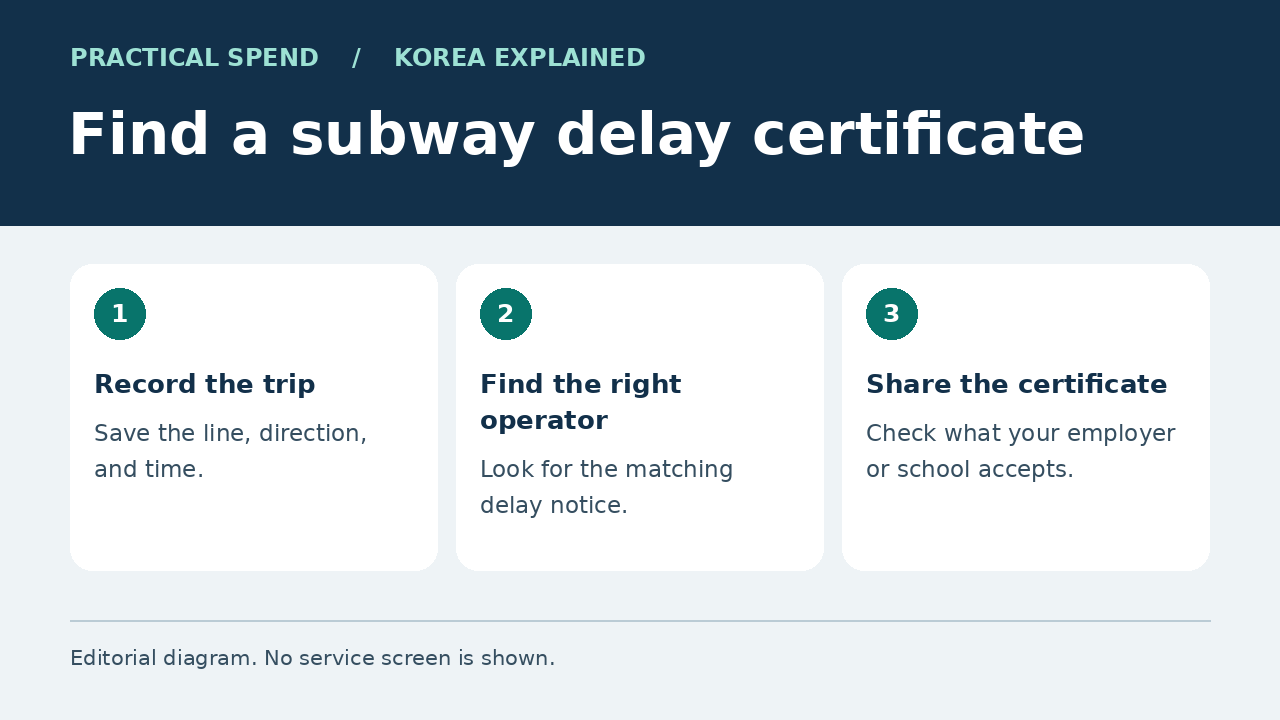
    Three cards show how to record the trip, identify the operator, and confirm what the recipient accepts as proof.
    Match the line, direction, and time before using a delay record. AI-assisted editorial diagram, not an actual service screen.

    Save your trip details while they are fresh

    Note where you boarded, the line and direction you were traveling, and the approximate time. If you changed trains, write down which leg was delayed. Two lines can share a transfer station, so the station name by itself may leave the person helping you unsure which service to check.

    Use Seoul Metro’s official service menu and select 간편지연증명서. 서울교통공사 is the Korean name shown for Seoul Metro. Seoul City’s guide describes choosing the delay entry for the relevant line and time and printing the certificate. When you find the entry, compare its details against your trip before downloading or printing it.

    If the delay does not appear

    Ask the station office for the operator’s current instructions. Seoul City’s published guide describes checking with station staff when a delay is missing from the website. Staff can tell you whether there is a record for the affected service and whether another operator should handle the request. This is particularly useful after a transfer, when the leg that made you late might be different from the line where you ended your journey.

    Here is a sample question to show a station employee: 오늘 [시간]쯤 [노선] 열차가 지연됐는데, 지연증명서를 받을 수 있나요? (“The [line] train was delayed around [time] today. Can I get a delay certificate?”) Fill in only the trip details that apply to you.

    Send the document with enough context

    Ask the recipient which format it wants, then include the certificate and a brief note giving the date and line. For instance, you might write, “My Line 4 commute was delayed this morning. I’ve attached the operator’s delay record for the relevant time.” The recipient decides whether the certificate meets its attendance or documentation policy.

    Official sources and verification

    • Seoul Metro official service menu displayed the delay-certificate option on November 11, 2026 (KST).
    • Seoul City: using a delay certificate describes choosing and printing a posted entry and asking station staff when a delay is missing. Seoul City: train delay certificates and workplace use describes employer-specific acceptance. Both municipal guides were checked November 11, 2026 (KST). They are older explainers, so current lookback periods and numeric thresholds are omitted.
    • Hands-on status: No certificate was issued or printed, and no station visit was made. The current date picker, covered segments, English support, and the recipient’s acceptance must be confirmed for the specific trip. Recheck the live flow before publication.
  • How to Search Korean Trademarks in KIPRIS Before Choosing a Brand Name

    How to Search Korean Trademarks in KIPRIS Before Choosing a Brand Name

    Before printing labels or naming a Korean storefront, use the free KIPRIS trademark database to search for the proposed name and plausible variations. KIPRIS is Korea’s public intellectual property search service. It offers an English interface and displays information on published trademark applications and registrations. Treat the results as a preliminary check before spending money on the name.

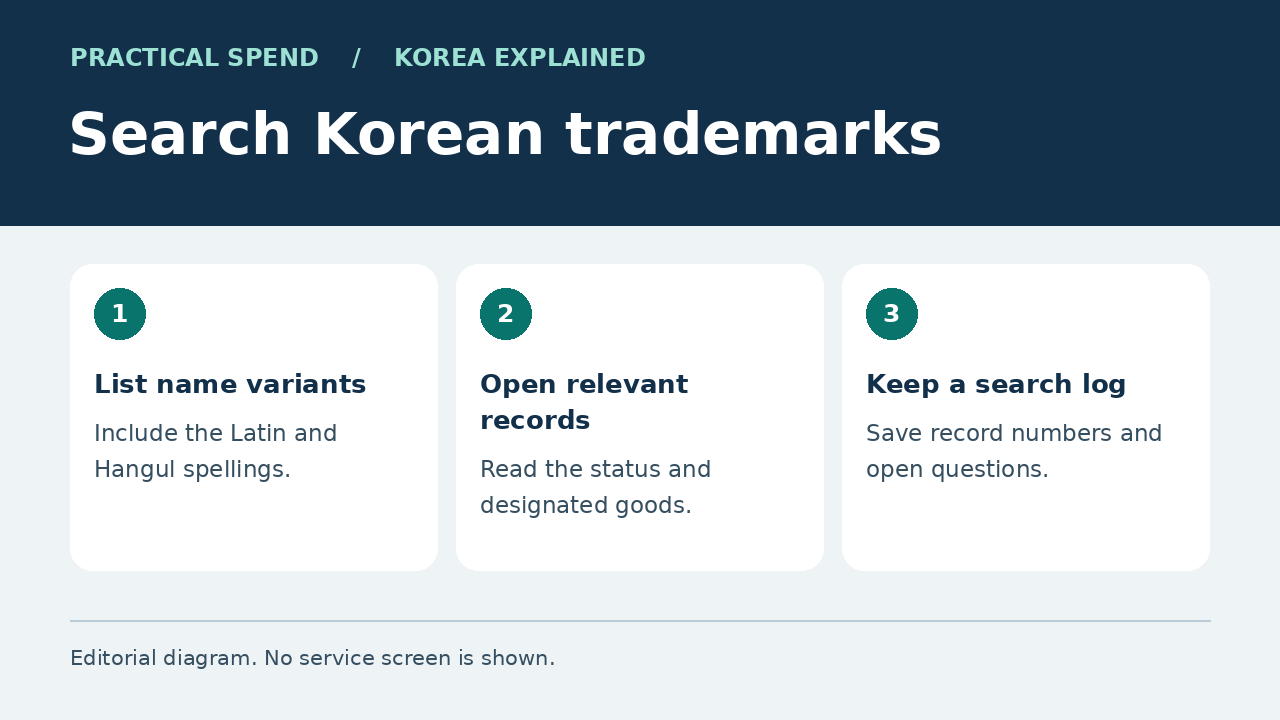
    Three cards show how to list brand spellings, compare Korean trademark records, and save a search log.
    Keep a dated list of the spellings and designated goods you searched. AI-assisted editorial diagram, not an actual service screen.

    Make a short list of search terms

    Write down the exact name, its most likely Hangul spelling, and plausible differences in spacing or spelling. If you expect customers to say the name aloud, consider how they might write what they hear. Start with the plain word mark even if you also plan to commission a logo. This list is a way to structure your search. It does not determine how an examiner would assess similarity.

    Open KIPRIS and choose Trademark under IP Search. On the Korean interface, 상표 means “trademark” and 상표명칭 means “trademark name.” Try the exact text first, then run each variation separately. If you use the exact-match filter, do a broader pass as well so you can review spelling variants.

    Read the record before drawing a conclusion

    Open close matches and note the mark, application or registration number, and the status shown in the database. Look for 지정상품, the designated goods or services associated with the record. The category label is a useful starting point. Read the specific goods and services too so you can explain how they relate to what you plan to sell.

    If your project involves both a product line and a service, write down each separately. Record the terms you searched, the search date, and the record numbers for any match worth another look. A dated log makes it easier to hand the search to someone else or repeat it after a name change.

    Decide which records need a closer look

    If a close match appears, save the record before deciding whether to keep investing in the name. For help with search fields, use the KIPRIS support guide. If the decision depends on whether a mark can be used or registered, seek a qualified review of the relevant records. Korea’s IP customer center explains that the official examination determines registrability. The public database is accessible to foreign users. This guide covers searching public records, with filing eligibility and representation outside its scope.

    Official sources and verification

    • KIPRIS public search and KIPRIS trademark search help support the Trademark section, match fields, record numbers, and designated goods fields. Checked November 11, 2026 (KST).
    • Korea’s IP Customer Center: how to search IP information supports free access, searchable application and registration information, and the role of official examination. Government KIPRIS update confirms language switching for Korean and foreign users. Checked November 11, 2026 (KST).
    • Hands-on status: No candidate brand was searched, and no clearance or filing was performed. Search results and statuses may change. Recheck the current records before making a brand decision.
  • How to Book a Free Tap Water Test in Seoul

    How to Book a Free Tap Water Test in Seoul

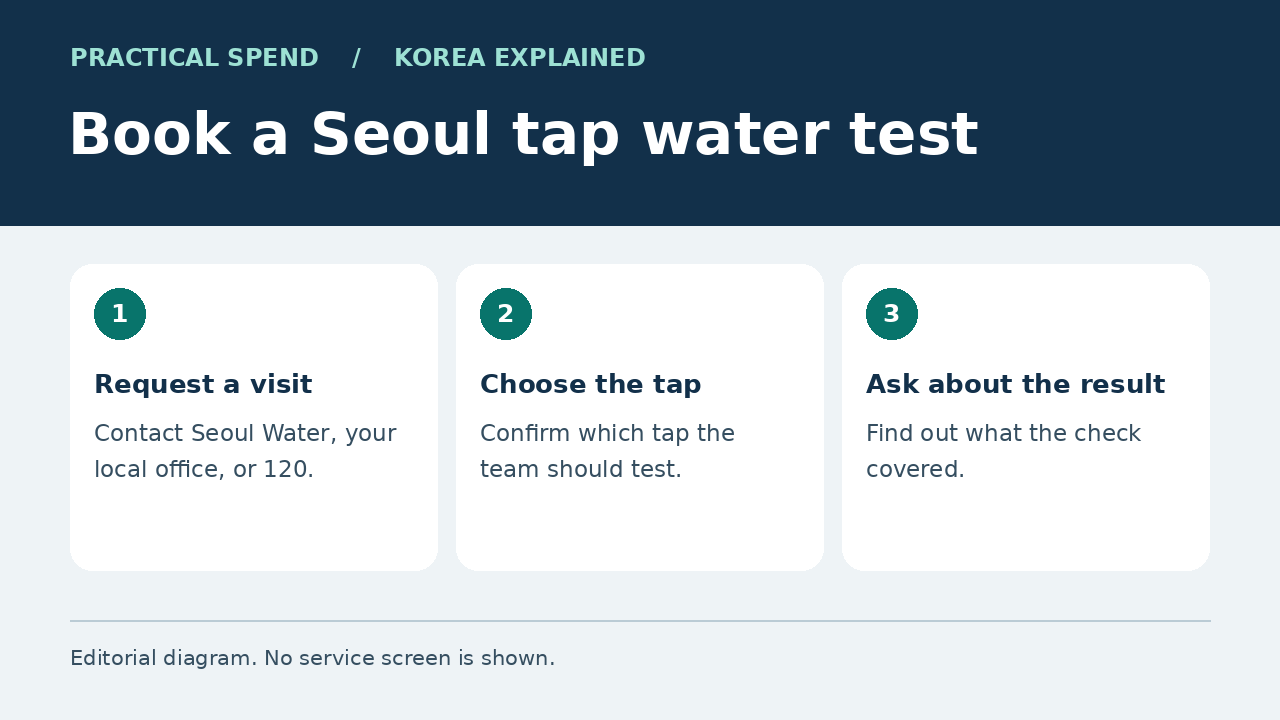
    If you live in Seoul and want your household tap water checked, request a free visit through the city’s Arisu Quality Verification System. Seoul Water describes it as a service for all households in Seoul. Book in advance through the 120 Dasan Call Center, the waterworks office serving your address, or Seoul Water’s Korean website. If you need an appointment in English, ask about language support when you book.

    Three cards show how to request a water test, identify the household tap, and ask what the result covers.
    Choose the tap you want inspected and ask which measurements the visit covers. AI-assisted editorial diagram, not an actual service screen.

    Request a visit for the address you live at

    Arisu (아리수) is Seoul’s name for its municipal tap water. On the Korean Seoul Water site, look for 아리수품질확인제, the Arisu Quality Verification System, and 수질검사 온라인신청, the online application for a water quality test. Have your address, the tap you want checked, and a few available time windows ready. If an apartment access or scheduling rule applies in your building, ask management how to coordinate the visit.

    Seoul announced expanded appointments until 9 p.m. on weekdays and 6 p.m. on weekends and public holidays, by reservation. Those hours describe the inspection program. Ask which slots are available for your address and how to confirm your appointment.

    Know what the basic inspection covers

    Seoul Water lists five basic indicators checked at the home: residual chlorine, turbidity, pH, iron, and copper. The result is reported on-site. Seoul Water also describes a further inspection if the initial checks fall outside its basic guidelines. If staff recommend a follow-up, ask who handles it, whether another sample is needed, and whether your building manager should be involved.

    If your concern is specific to one faucet, tell the team when you make the request. For example, “The kitchen tap is the one I want checked. Can you confirm that the appointment is for that tap?” After the visit, record which tap was sampled and what the team tested. A test at one tap answers a different question from a building-wide check or a test for an additional substance.

    Before you book

    Confirm the address, appointment window, and access arrangements. Ask the office what to do if you need to reschedule and whether it can provide a written result or explain the findings in English.

    Official sources and verification

  • How to Call Korea’s 1345 Immigration Helpline in English

    How to Call Korea’s 1345 Immigration Helpline in English

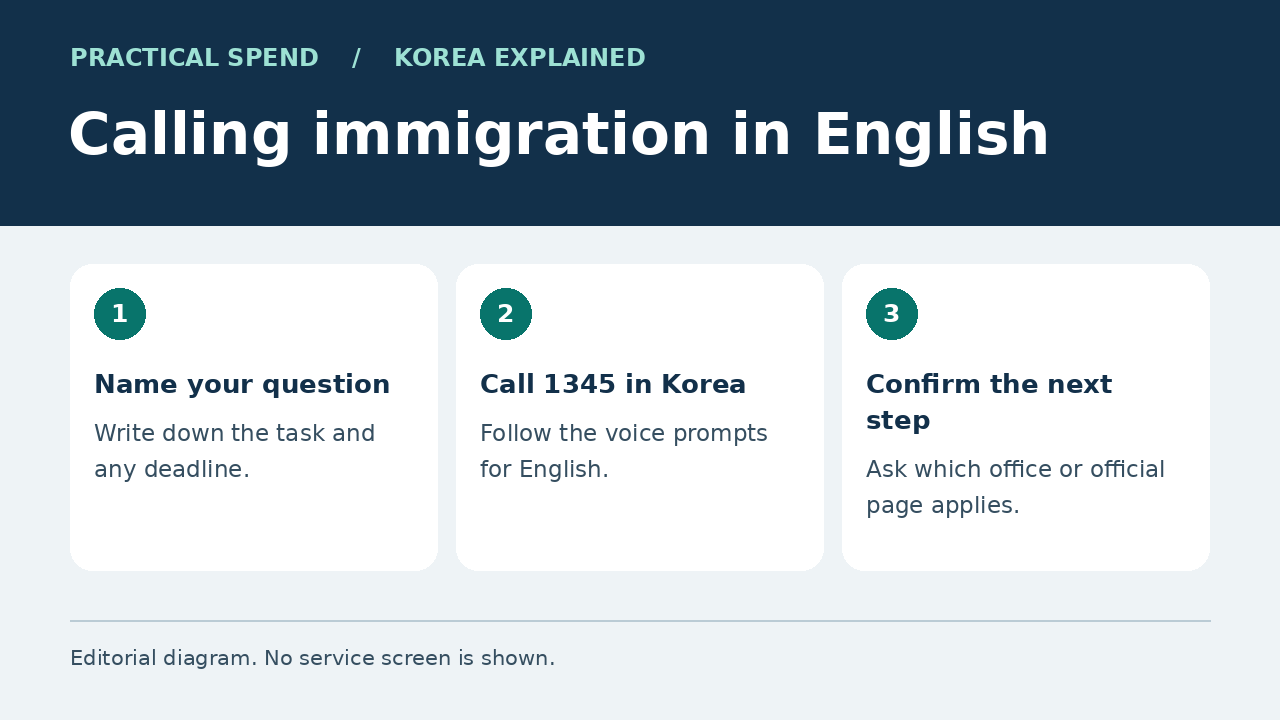
    If you need to ask Korean immigration which office or procedure applies to you, call 1345 from a landline or mobile phone in Korea and follow the recorded menu for English. The Korea Immigration Service lists counseling from 9 a.m. to 10 p.m. Korea time on weekdays, with public holidays excluded. English remains available after 6 p.m., when service is limited to Korean, English, and Chinese. The Ministry of Justice lists 1345 as a paid call.

    Three cards show how to prepare a question, call Korea’s 1345 line in English, and confirm the next official step.
    Prepare one question and write down the office or official page the counselor identifies. AI-assisted editorial diagram, not an actual service screen.

    Prepare a question the counselor can answer

    Write down the task you are trying to complete and the deadline, if one appears on an official notice. Keep the name of the relevant city or district and any official form title handy. If you need to explain your status, have the official wording in front of you so you can read it accurately. Start with the administrative question. You can ask what identifying information the counselor needs if a case-specific lookup comes up.

    For example, “I live in Mapo-gu. Which immigration office handles this request for my address? Could you give me the Korean name of the procedure and tell me where to read the current instructions?” This example illustrates how to ask for a route. The correct office depends on the request and your circumstances.

    Follow the language menu

    The agency’s English instructions say to select the announced language number and press the star key. Listen to the current recording so you can follow the right sequence. The English page also lists +82-2-6908-1345 and +82-2-6908-1346 among its international contact numbers. International connection and calling charges may depend on your carrier.

    Confirm what to do after the call

    Write down the office name, the Korean service or form title, the next step, and any deadline the counselor identifies. Ask which official page shows the requirements for your specific situation. If the answer involves an appointment, ask whether booking is required before you travel. Keep a copy of any existing notice and check the formal instructions it gives you.

    The contact center provides information for foreign residents on immigration and daily life. Eligibility for a particular application, what documents it accepts, and the effect of a deadline depend on the procedure and the applicant. This guide covers how to contact the service.

    Official sources and verification

    • Korea Immigration Service: Immigration Contact Center supports the audience, scope, English menu, operating hours and international numbers. Checked November 11, 2026 (KST).
    • Ministry of Justice contact directory confirms the weekday schedule, public-holiday exclusion, and paid domestic call. Checked November 11, 2026 (KST).
    • Hands-on status: No call was placed. Wait times, international connections, and individual eligibility or document requirements were not tested. Recheck the hours and menu before publication.
  • How to Track a Korea Post EMS Package Sent Abroad

    How to Track a Korea Post EMS Package Sent Abroad

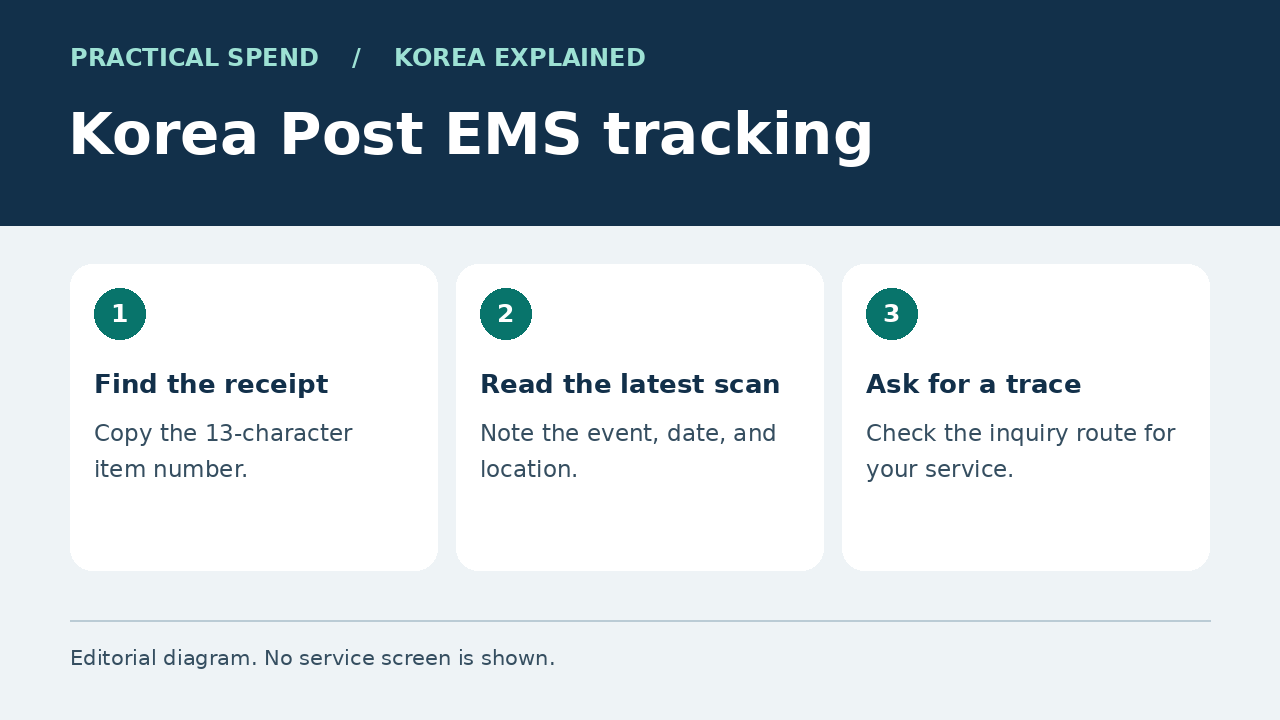
    If you sent a package abroad with standard Korea Post EMS, copy the 13-character item number from the receipt into the ePOST tracker. If the tracking history stops updating, check the destination postal operator with the same number before filing an inquiry. Check the receipt first if you are unsure whether you bought standard EMS or EMS Premium. Korea Post gives Premium its own inquiry route.

    Three cards show how to find the EMS receipt number, read the latest scan, and check which service handles a trace.
    Keep the receipt and the latest tracking event together before requesting a trace. AI-assisted editorial diagram, not an actual service screen.

    Start with the receipt

    Find the service name, mailing date, destination country, and item number. On the official ePOST page, 우편물번호 means “postal item number” and 행방조회 means “tracking.” The page also offers an English link. Copy the entire number, including the letters at both ends, and make sure you are using the number for the right parcel if you mailed more than one.

    Record the most recent event, its date, and the location shown. A scan tells you what the tracker recorded at that point. If the latest event shows departure from Korea, you can tell the recipient what the tracker shows and when you last checked it. Leave the expected arrival date open until the carrier provides more information.

    Check the destination postal operator

    Korea Post’s tracking page links to foreign postal operators, and its inquiry form asks senders to check the destination country’s tracking site first. Enter the same item number there. If that site shows a more recent event, save it alongside the Korea Post result. If there is still no useful update, have both results ready when you contact Korea Post.

    Ask for a trace if tracking stops

    Korea Post’s English Internet EMS Inquiry form asks for the item number, sender and addressee details, the reason for the inquiry, and contact details for the response. Have the posting receipt ready. For standard EMS, the form states that the claim must be received within four months, counted from the day after posting. It lists separate terms for Guarantee Service and K-Packet. Ask about the deadline promptly if you are unsure which service is on the receipt.

    Korea Post lists 1588-1300 on weekdays from 9 a.m. to 6 p.m. Korea time, with caller charges and closures on Saturdays and public holidays. For EMS Premium, its English inquiry page directs readers to 02-3700-5199. An English form is available for the standard inquiry route. English phone support was not confirmed.

    Official sources and verification

    • Korea Post ePOST tracking supports the 13-character lookup, destination postal links, and customer-center hours and charges. Checked November 11, 2026 (KST).
    • Korea Post English Internet EMS Inquiry supports the destination-site check, form fields, standard EMS deadline, and EMS Premium referral. Checked November 11, 2026 (KST).
    • Hands-on status: No parcel number was entered, inquiry submitted, or call placed. Tracking coverage and delivery scans depend on the destination and item. Recheck deadlines and phone hours before publication.
  • How to Look Up Korean Form Terms in the Official English Dictionary

    How to Look Up Korean Form Terms in the Official English Dictionary

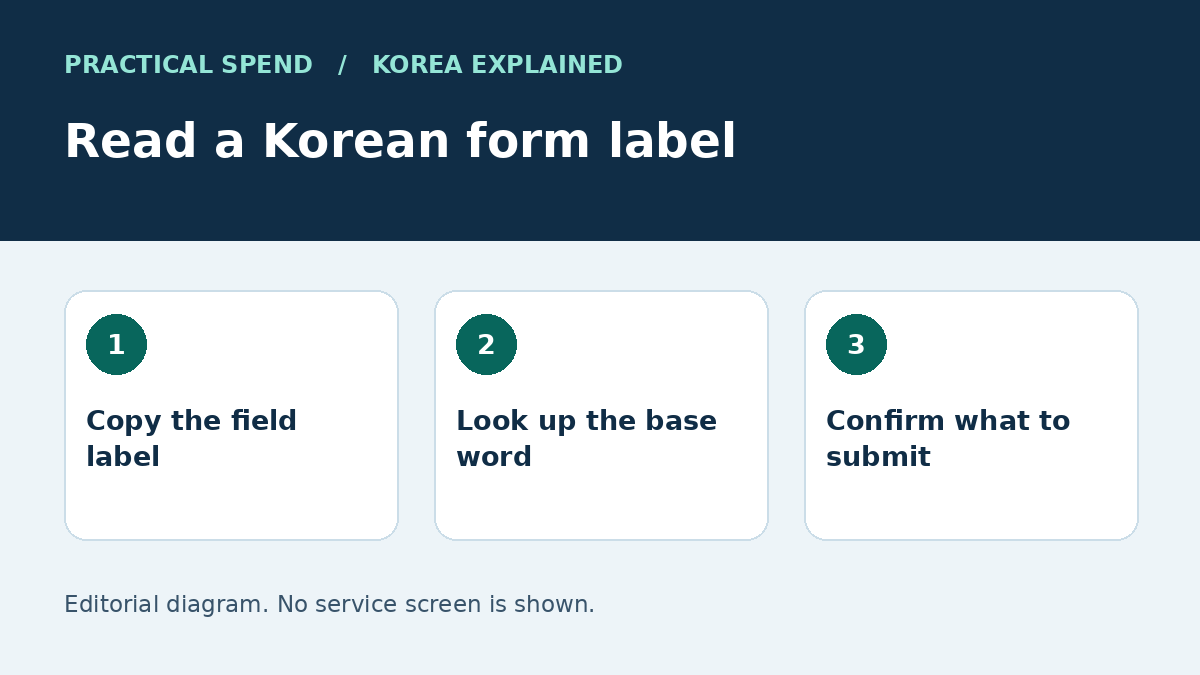
    If you are filling out a Korean form and get stuck on a field label, look up its key word in the National Institute of Korean Language’s Korean-English Learners’ Dictionary. The official tool accepts Korean or English search terms. Once you understand the word, use the issuing office’s current instructions to find out exactly what it wants you to enter or submit.

    Three steps for reading a Korean form label: copy the label, look up the base word, and confirm what to submit.
    Original AI-assisted editorial diagram. Not an actual product or service screenshot.

    Start with the label, then read the surrounding instruction

    Copy only the unfamiliar label. For a long phrase, search the main noun or verb first. In 제출 서류 (documents to submit), for example, you can look up 제출 (submission) and 서류 (documents) separately. Then read the line below the heading to see which documents the office actually lists.

    Label you may seeWorking meaningWhat to check
    신청인ApplicantWhose name goes in this field?
    제출 서류Documents to submitWhich documents and file formats does the office accept?
    접수Receipt or intakeHas the office received the form, and where can you check its status?
    구비 서류Required supporting documentsDoes the checklist vary by applicant type?

    These are language examples. The form and the office’s guidance determine the procedure.

    Ask one question the office can answer

    Suppose a form says 신분증 사본 (copy of an identity document). Understanding the phrase still leaves a practical question about which document the office accepts for your application. Ask, “Which identity document do you accept for this application, and do you need a paper copy or an upload?” Give the form title and field label. Use the official submission channel if the office requests the document.

    Before submitting

    Check the form version, required fields, document list, and deadline on the issuing office’s website. If the page shows 접수, check the status guide or confirmation notice for what happens next. Keep the official instructions and any receipt together so you can refer to them if the office asks for a correction.

    Official sources and evidence

    • Confirmed in official documentation — Official bilingual dictionary interface, Korean or English search input and advanced search. Checked November 10, 2026 (KST). National Institute of Korean Language — Korean-English Learners’ Dictionary
    • Editorial guidance — Checklists, suggested questions and hypothetical examples are editorial applications of the cited guidance.
    • Unverified and hands-on status — No real form was filed. The labels are editorial language examples. Accepted documents, ID requirements, submission format, and deadlines are specific to the issuing office.
    • Recheck — Check the current official guidance before using the service; procedures, prices and contact routes can change.
  • How to Rent and Return a Seoul Public Bike

    How to Rent and Return a Seoul Public Bike

    For a short errand or the last leg of your Seoul commute, use the Seoul Bike app to buy a pass and unlock a Ttareungi (따릉이), Seoul’s public bike. Pick a pass based on how long you will keep the bike out at one time. At the end of the ride, lock it at a Seoul Bike station and check your phone for the return confirmation.

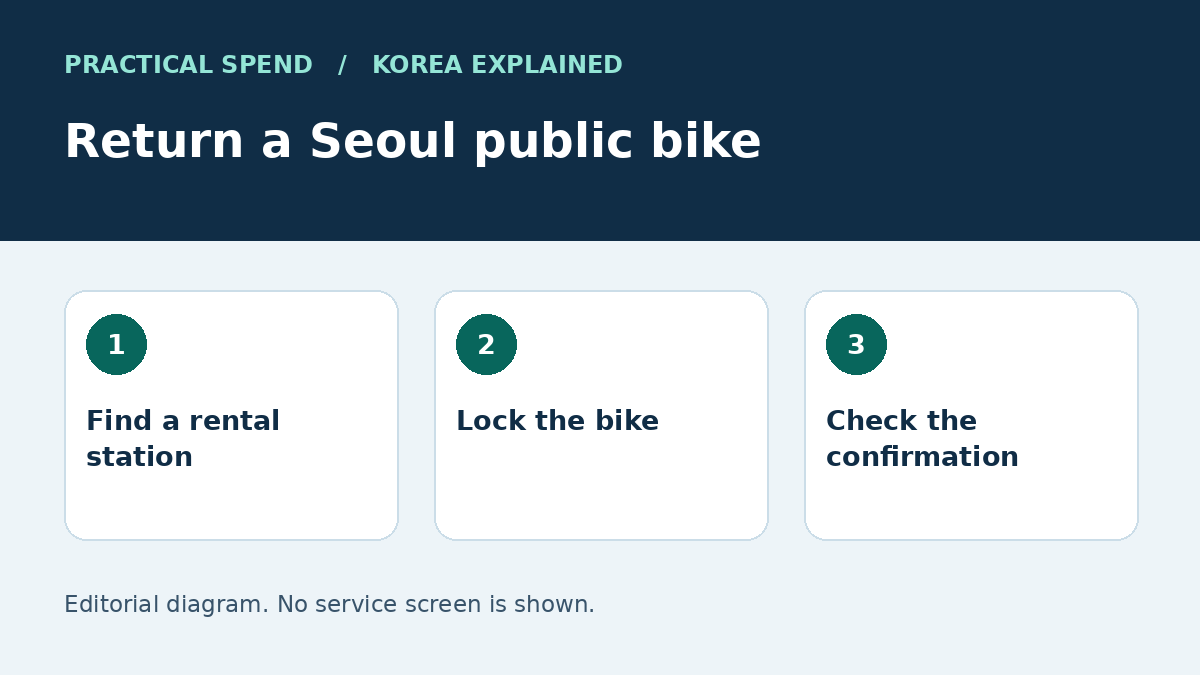
    Three steps for returning a Seoul public bike: find a rental station, lock the bike, and check for confirmation.
    Original AI-assisted editorial diagram. Not an actual product or service screenshot.

    Choose a pass for the longest leg of your trip

    Nonmember day passTime per rentalListed price
    General60 minutes₩1,000
    Premium120 minutes₩2,000
    Three-hour180 minutes₩3,000

    A day pass and the timer on an individual rental measure different things. For the 60- and 120-minute products, the city explains that you can return the bike within the rental window and rent again while the pass is valid. Check the price, overtime conditions, and payment options in the app before buying.

    Rent, ride, and confirm the return

    1. Find a rental station near your starting point and another near your destination. Allow time to reach the return station before the rental timer expires.
    2. Buy your pass in the Seoul Bike app. At the station, scan the bike’s QR code or enter its number as directed in the app.
    3. At the return station, lock the bike as directed. Check your phone for the return confirmation before leaving.
    4. If you cannot confirm the return, note the station and bike number and call the operating center at 1599-0120. The city lists additional charges for late returns.

    Example: If you ride 20 minutes to a library and plan to spend an hour there, return the bike before entering. For a General day pass, you can start another rental for the ride home while the pass is valid, subject to bike availability.

    Before your first commute

    Check the return location and leave a few minutes for locking and confirmation. Use the city’s English instructions to review the steps before standing at a station with the timer running. The published instruction panel is labeled October 2023, so follow the current app and bike prompts if their wording differs.

    Official sources and evidence

    • Confirmed in official documentation — Nonmember day-pass prices, per-rental timing, additional fees, and operating center. Checked November 10, 2026 (KST). Seoul Metropolitan Government — Seoul Public Bike costs
    • Confirmed in official documentation — Official app, QR or bike number, physical locking, and phone confirmation. Checked November 10, 2026 (KST). Seoul Metropolitan Government — How to rent and return
    • Editorial guidance — Checklists, suggested questions and hypothetical examples are editorial applications of the cited guidance.
    • Unverified and hands-on status — No pass was bought or ride taken. Foreign-issued card acceptance, live station availability, and current app labels were not tested.
    • Recheck — Check the current official guidance before using the service; procedures, prices and contact routes can change.
  • How to Text Seoul’s 120 Helpline in English

    How to Text Seoul’s 120 Helpline in English

    Need to ask Seoul City a question about a local service in English? Text 02-120 on weekdays from 9 a.m. to 6 p.m. Korea time. Seoul’s 120 Dasan Call service answers questions about city administration and everyday services such as transportation and water. Seoul says it charges no additional consultation fee. Your mobile plan’s standard text charges apply.

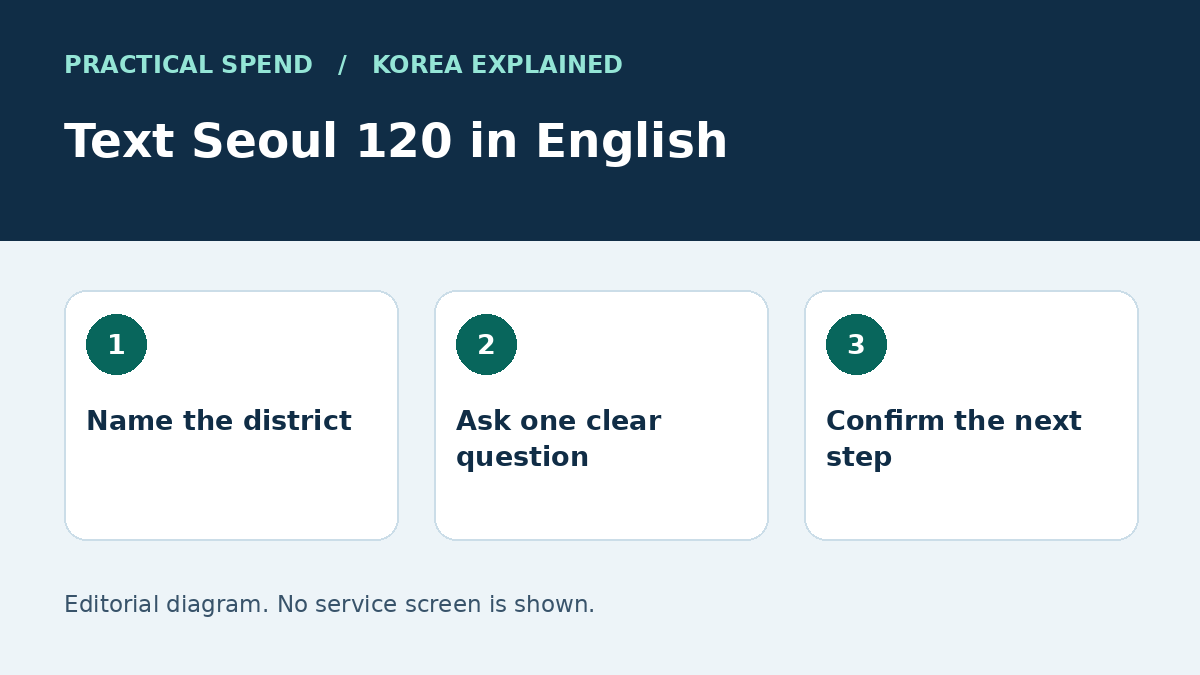
    Three steps for texting Seoul 120: name the district, ask one clear question, and confirm the next step.
    Original AI-assisted editorial diagram by Practical Spend. This is not a service screenshot.

    What to put in your first message

    1. Name your district, or gu, and the neighborhood or station if it matters.
    2. Ask one question and say what you want back. A department name, an official link, or an office address is often enough to get started.
    3. If the answer points to another office, ask for its Korean name and contact information. That gives you something concrete to search or show at a counter.

    Example message: “Hello. I live in Mapo-gu. Which office handles questions about an apartment water bill? Could you send me the office name and an official link?” This is a sample message.

    When to call instead

    Seoul also lists an English phone route. Call 02-120 and press 9 for foreign-language consultation. If your question has several parts or you need to explain an earlier reply, a call may be easier. Check the current hours for the language channel you need.

    The text service helps you identify the right city office or procedure. For a document submission, ask which official channel accepts it. Keep passport numbers, bank details, and document photos out of your opening text.

    Before you send

    Confirm that you are sending a mobile text to 02-120, include the district, and ask for the action you need to take next. If you are outside the published English text hours, check the current help options before relying on a reply.

    Official sources and evidence

    • Confirmed in official documentation — English SMS number and weekday hours, city-service scope, standard messaging charges, and English phone route. Checked November 10, 2026 (KST). Seoul Metropolitan Government — English text consultation launch
    • Editorial guidance — Checklists, suggested questions and hypothetical examples are editorial applications of the cited guidance.
    • Unverified and hands-on status — No SMS or phone call was placed. Holiday availability, response time, and delivery from overseas SIMs or Wi-Fi messaging apps were not tested.
    • Recheck — Check the official guidance again before relying on operational details, because procedures, hours, and contact routes can change.

    For a related city-service guide, see Seoul Public Libraries: A Membership Guide for Foreign Residents.

  • Seoul Public Libraries: A Membership Guide for Foreign Residents

    Seoul Public Libraries: A Membership Guide for Foreign Residents

    A public library can be a useful low-cost place to borrow books, study, use Wi-Fi, or find Korean-language learning materials. The confusing part is that “Seoul public library” does not mean one uniform membership system: individual libraries may set different registration steps and document requirements.

    This guide focuses on how to check eligibility before you go. It is based on current Seoul government information and library guidance, not on a personal visit or a membership test.

    Start with the right library

    Use Seoul’s official public-library directory to find a branch near your home, school, or workplace. Check that branch’s own membership page before preparing documents. Seoul’s foreign-resident portal says foreign residents may use public libraries after registration, but also warns that each library can have different membership criteria and required documents.

    For Seoul Metropolitan Library specifically, Seoul city reported that online registration was expanded to allow citizens and foreign residents in Korea to borrow books nationwide from June 10, 2025. Confirm the current registration flow on the library’s own site because service details can change.

    What to check before visiting

    Look for these items on the library’s official page or call the branch:

    • Eligibility: Does the branch serve residents of a particular district, people who work or study in Seoul, or a wider group?
    • Identification: The Seoul foreign-resident portal lists an Alien Registration Card or domestic residence report, and says a passport may be needed depending on the library.
    • Registration method: Some libraries may require online signup followed by in-person identity or address confirmation.
    • Services: Ask whether your membership includes physical borrowing, e-books, study rooms, computers, or cultural programs. Access may differ by service.
    • Card format: Check whether the branch issues a physical card, mobile card, or both.

    Bring the original identification requested by the specific library. Do not rely on an older blog post or assume another branch’s rules apply.

    A simple first-visit workflow

    1. Search the official directory for a convenient library.
    2. Open that library’s current membership instructions.
    3. Confirm foreign-resident eligibility, address rules, and documents.
    4. Complete any online registration the branch requires.
    5. Visit with the requested ID if in-person confirmation is required.
    6. Ask staff to show you how to access the catalog and any digital services included in your membership.

    If you mainly want e-books, verify that the membership type you receive includes digital borrowing. A physical card and an online account may not unlock exactly the same services at every library.

    Cautions

    This is a Seoul-focused guide, not a nationwide rulebook. Library membership, borrowing limits, renewal periods, and digital collections can differ by institution and can change. The city’s announcement about Seoul Metropolitan Library’s expanded eligibility is specific to that service; it should not be treated as proof that every branch follows identical rules.

    Avoid sharing your ID image or personal number through unofficial messages. Use the library’s official site or contact channel for registration questions.

    Before-you-go checklist

    • Choose a branch using Seoul’s official directory.
    • Read the branch’s current membership instructions.
    • Confirm the exact ID and address documents.
    • Ask whether e-books and study spaces are included.
    • Save the library’s contact details and operating hours.
    • Keep a note of any account or card activation step.

    A short check before leaving home can prevent a wasted trip. Start with one nearby branch and verify its rules directly before you plan around its services.

    FAQ

    Can foreign residents join a public library in Seoul?

    Seoul’s foreign-resident portal says foreign residents can use public libraries if they meet applicable requirements. Individual library criteria may differ, so check the selected branch.

    Is an Alien Registration Card always enough?

    Not necessarily. Seoul’s guidance lists it as a possible document, but notes that libraries may have different requirements; some may ask for additional proof or a passport.

    Does one library card provide e-book access?

    That depends on the library and membership type. Confirm digital borrowing directly with the library before relying on it.

    Sources and research record

    Checked November 9, 2026:

    1. Seoul Foreigner Portal, Public Library Use — eligibility caveat, document examples, and available service types.
    2. Seoul Metropolitan Government, Seoul Metropolitan Library expands loans nationwide — official 2025 announcement about Seoul Metropolitan Library’s expanded online borrowing access.
    3. Seoul Metropolitan Office of Education, Operation of Libraries — registration guidance for its library system; branch/system-specific requirements.